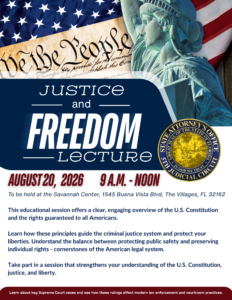
In celebration of the United States’ 250th year of independence, join the State Attorney’s Office for a special educational session on the Constitution and the rights it guarantees every American. This engaging class will explore the Bill of Rights, key Supreme Court cases, and how these protections apply in everyday life and in the courtroom. Learn how our justice system upholds these foundational freedoms – and why staying informed is essential to being an empowered citizen.
Listen to how these rights apply to everyday life:
•Criminal procedure rights guarantee that a person accused of a crime is entitled to a speedy and public trial, the right to counsel, the right to confront witnesses, and protection against self-incrimination.
•Individual liberties are fundamental rights that protect individuals from government overreach and ensure freedoms such as speech, religion, and due process – though they are often balanced against public safety and the rights of others.
•Privacy Rights are integral and moral entitlements that protect an individual’s right to be free from unwanted interference and to control their personal information and life. These rights are crucial for maintaining autonomy, securing personal boundaries, and protecting individuals from unwarranted intrusion into their personal affairs, home, and communications.
See how these rulings affect modern law enforcement and courtroom practices:
•Gideon v. Wainwright (1963): Guaranteed the right to an attorney for indigent defendants in felony cases.
•Miranda v. Arizona (1966): Required police to inform suspects of their constitutional rights, including the right to remain silent and the right to an attorney, before custodial interrogation.
•Katz v. United States (1967): Determined that the Fourth Amendment’s protection against unreasonable search and seizure applies to electronic surveillance, based on whether a person has a “reasonable expectation of privacy” in a given space.
•Carpenter v. United States (2018): Held that the government needs a warrant to access a person’s historical cellphone location data, recognizing this data as sensitive information that is protected by the Fourth Amendment.
•Tinker v. Des Moines (1969): Protected students’ right to symbolic free speech in public schools, as long as it doesn’t disrupt the educational environment.
•United States v. Grace (1983): The Court ruled that the First Amendment protects the right to protest on sidewalks outside the Supreme Court building, as sidewalks are traditional public forums for expressive activities.
Upcoming Lecture
Our next Justice & Freedom Lecture will be held at the Savanah Recreation Center (located at 1545 Buena Vista Blvd, The Villages, FL 32162), on Thursday, August 20, 2026, from 9 am-12 pm.
If you would like to apply for the upcoming sessions, please complete the application available below or click here to download a fillable form to mail (Attn: Brittney Carman, Public Information Officer, 110 NW First Avenue, Suite 5000, Ocala, FL, 34475). For any questions or concerns, email community@sao5.org.